By Our Love - Final Polity Paper
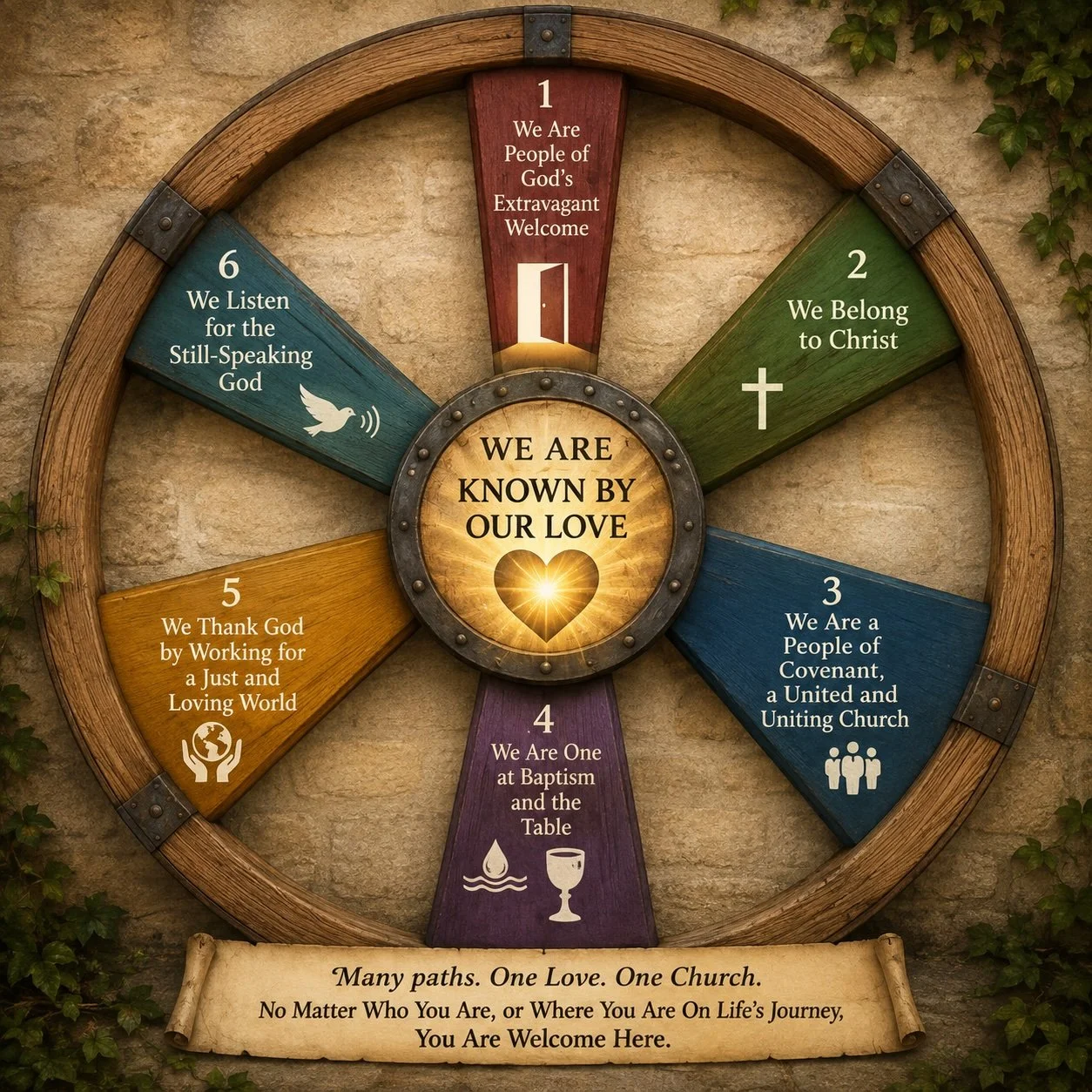
The Hub of Love: Fowler's Six Vital Themes of Our Faith
Visual interpretation by Shala Hillman, based on Sidney Fowler's What Matters to You? Matters to Us and the “Hub of Love” metaphor taught to me by my grandmother, Rev. Charlottie Havlicak. Image created with ChatGPT/OpenAI.
What Matters to You? Matters to Us: The Six Vital Themes of Our Faith
Sidney Fowler’s What Matters to You? Matters to Us explores six vital themes that describe the theological identity of the United Church of Christ. These themes are: We Are People of God’s Extravagant Welcome; We Belong to Christ; We Are a People of Covenant, a United and Uniting Church; We Are One at Baptism and the Table; We Thank God by Working for a Just and Loving World; and We Listen for the Still-Speaking God. Viewed independently, they each point to the ways the United Church of Christ believes in its vision of continually asking what it means to be the Church in our time and context. Viewed as a whole, these themes show how the UCC prioritizes covenant and community as markers of ecclesiology rather than relying on simple adherence to historic doctrine to maintain Christian identity and tradition.
With these themes, Fowler posits that the UCC prioritizes diversity over conformity, while still engaging with the mission of Christian unity and, for this reason, retains strong support for local church autonomy to encourage that diversity. By emphasizing covenant over conformity, each local church can retain the unique blend of culture, generation, and traditions that have made it home to its members. This is one of the many things I love about the UCC; you can visit ten different UCC congregations and come away with ten completely different experiences and yet, be completely confident that each abides by the uniting phrase, “No Matter Who You Are, or Where You Are On Life’s Journey, You Are Welcome Here.”
I think these six themes accurately describe much of what is distinctive and compelling about the UCC, and I would not remove any of them. I would, however, add a seventh: We Are Known By Our Love. Growing up in my grandmother’s UCC congregation in Idaho, we frequently sang the song, They’ll Know We Are Christians By Our Love. The traditional lyrics are:
We Are One in the Spirit, We are One in the Lord, And We Pray that all unity may one day be restored and they’ll know We are Christians By Our Love, By Our Love, yes, they’ll know We Are Christians By Our Love.
I revised this first verse as:
We are One in the Spirit, We are One in Your Love, We are One in the Spirit, We are One in Your Love. May the friend and the stranger feel the welcome of Your Love, and They’ll Know We Are Christians By Our Love.
The next two verses describe working side by side and walking hand in hand.
I revised the last verse to more inclusive language:
May Your Wisdom guide us on the path that we walk, May Your Mercy guide us in the ways that we talk. May the friend and the stranger feel the Welcome of Your Love.
The purpose of revising this language was to perform and sing it at the Annual Celebration this year. I highlight this as a perfect example of the UCC's precedent and flexibility to continually examine language that may not reflect the inclusion of everyone singing with me. I was not bound by tradition or the worry that people would be upset by changes to the language, and I could err on the side of ensuring that everyone singing with me could recognize themselves as belonging within the words.
The message of this song and my proposed seventh theme, We Are Known By Our Love, is woven into all six of Fowler’s themes, but I feel an explicit mention of what we are known for first and foremost helps explain them even better. When people ask me to explain the theology of the UCC, I always use my grandmother’s explanation of The Hub Of Love, which she told me many years ago. “Picture an old-fashioned wagon wheel. The kind the pioneers drove and picture the big metal hub in the middle. Can you see that hub? That hub is God’s Love, and all of our religious differences and spiritual paths are the spokes running out of it. We are all connected by that Love and bound together, traveling to the same destination, back into the arms of Love.” One could also envision these themes as the spokes of a wheel that have We Are Known By Our Love as the central, uniting theme that binds them all together and moves each generation forward in the spiritual authority of Love.
We Are People of God’s Extravagant Welcome
The first spoke in this version of the Hub of Love is Fowler’s first theme: We are people of God’s extravagant welcome. The word extravagant is so vital to this sentence because it drives home the assurance that we do not simply tolerate differences of culture, tradition, and experience; we celebrate them! We know that our diversity makes us stronger, more agile, and more aware of the needs of the people around us in our communities. It is the welcome of the father in the parable of the prodigal son, extravagant and exuberant, that those searching for belonging and connection have found their way home to us.
It is not simply a policy either; it is rooted in the theological foundation of the UCC: the claim that God’s grace far exceeds any boundary the human mind and heart can create in attempting to distinguish or prioritize oneself or a group above the ‘other’. This extravagant welcome also implies that we are willing to be changed by those that accept the offer of it; we are not simply saying “we won’t kick you out because you’re different”; we are saying, “ we welcome your traditions and ways of worshipping and are willing to make them our own. This extravagant, intentional welcome is radically different from simply having an open-door policy.
We Belong to Christ
So if the first theme/spoke exclaims extravagant welcome and belonging, then it makes sense to clarify Who and what we all belong to. Again, the language of belonging is so important here: we belong to Christ rather than simply believe in Him. Our beliefs may differ and, in fact, are celebrated for doing so, but, as Fowler highlights, our belonging to Christ unifies us. And we have the example of Christ displaying that welcome, truly God’s unitive Love, to each person he encounters in the gospels; his ministry and message are oriented around and point to the way God loved us first before we even knew we needed it.
This belonging to Christ then follows to belonging to each other, as a family does. And as a family that belongs to Christ and each other, we orient our words and deeds toward the teachings and radical Love that Jesus promised. The belonging does not come from creeds or attestations of belief; it comes from living out the Love of God and being known for it. As diverse as the UCC congregations are around the world, we are bound by our common belonging to Christ, and we know nothing can separate us from the Love that is in Christ Jesus. (Romans 8:39)
We Are a People of Covenant, a United and Uniting Church
Being in covenant, having a commitment to remaining in relationship, is vastly different from striving for conformity. Fowler's third theme/spoke allows for local church autonomy without becoming independent, which could result in isolation. The foundation and heritage of the UCC is rooted in four historic streams uniting into a united church, one that is oriented to Love and belonging to Christ, knowing that the work of unity is always in progress, never complete. As in the example of the fifth stream, the African-American stream, the UCC recognized a foundational omission, and its polity allowed for the recognition and recovery of a history the older narrative failed to name.
Allowing for so much diversity and flexibility certainly presents challenges in answering social or theological issues, but the benefits of it far outweigh the impulse to silence or ignore the minority in favor of the majority. And the simplicity of the concept does not diminish the difficulty of remaining in covenant when things get messy or hard. But covenant is not a bond that breaks easily. Being in covenant does not erase our differences or our historic traditions and cultures; it simply allows them to “walk hand in hand” with each other instead of competing against each other. It reinforces the extravagant welcome one congregation extends to another; the welcome and celebration to bring its wisdom, talent, and experience to the benefit of the entire family, the wider UCC. In a deeply polarized world, this example of holding differences in tension with belonging truly allows that world to know us by our Love.
We Are One at Baptism and the Table
Fowler’s fourth theme moves covenant from an abstract theological idea into embodied Christian practice. Baptism and Communion remind us that Christian identity is not merely intellectual. It is lived through community, ritual, memory, and shared sacred experience.
At baptism, we affirm belonging within the Body of Christ. At the Communion table, we repeatedly return to that belonging. We arrive with different backgrounds, identities, theological beliefs, political convictions, successes, failures, joys, and wounds, yet we receive from the same table. I heard a beautiful Biblical illustration of this from a sermon by Pastor Mike McClure of the Rock City church in Alabama. In 2 Samuel 9, King David seeks any remaining relatives of his faithful friend Jonathon and asks them to be brought to his table. They find one son, Mephibosheth, and also tell David that this son is lame in both feet. And what does David do? He commands him to come: “So Mephibosheth dwelt in Jerusalem: for he did eat continually at the king's table; and was lame on both his feet.” Pastor McClure says, “What does a table do when we’re seated at it together? It hides our feet.” I would take the image one step further: the table does not require that the feet beneath it look the same. What matters is that everyone has been given a place. It requires us to make room, and it allows everyone their fair portion. We learn when to take and when to give. The table is a place of instruction, learning how to be in community, as much as a place of communion. We may not have as many hard-and-fast doctrinal positions as other denominations, but these sacraments of baptism and communion remain at the core of our covenantal bond and are woven into our practice.
We Thank God by Working for a Just and Loving World
Fowler’s fifth theme could be summed up by the wording in my church’s offering call, “We Respond to God’s Voice.” We respond, we take action, we live into our calling to be known by our Love through meaningful intervention, not simply promising to pray and deferring responsibility when we can make discernable, tangible differences in the lives of people in our community and world. This also answers the call for nurture, service, and transformation as evidence of living, faithful discipleship. Justice requires that the inner work of personal transformation become evident in the Church's outer work. As we grow in the conviction that each person belongs at the table of Christ, we work to ensure they have a way to get there. “We will work with each other, we will work side by side. And we’ll guard each one’s dignity and save each one’s pride. And they’ll know we are Christians by our Love.”
For me, justice and love cannot ultimately be separated. Justice is love made public. It is love refusing to remain sentimental when another person is suffering. The UCC has made meaningful strides in engaging in social justice, especially around racial and LGBTQ+ marginalization, as well as areas that disproportionately impact them, such as economic and environmental justice. It has also made meaningful strides with each misstep or omission, learning to anticipate what it might not be seeing from each time it falls short. When the UCC does fall short of grasping the whole picture, it actively seeks reconciliation and repair; it responds to the discerning voice of the Holy Spirit, which is still speaking.
We Listen for the Still-Speaking God
The imagery of the hub and the wheel continues in powerful progression in Fowler’s sixth theme/spoke; the church can pursue justice in the world and make corrections when needed because it is still responding to God’s voice. The phrase “God is still speaking” communicates both humility and hope. It acknowledges that our understanding of God is never complete. And that’s ok, because as Father Richard Rohr says, “Remember, mystery isn't something that you cannot understand – it is something that you can endlessly understand! There is no point at which you can say, “I've got it.” Always and forever, mystery gets you!” God’s Love for us is truly a mystery; not because we are broken sinners but because it is so infinite and our understanding cannot be exhausted by it. My favorite hymn is What Wondrous Love Is This, Oh My Soul. It eclipses the mind but engulfs the soul.
As a chaplain, I have learned from and leaned on the still-speaking voice of the Spirit in encounters when I am mystified because the experience and pain of the person in front of me eclipses my own understanding and tempts me to lean on that understanding alone. When I am drawn into relation with the Spirit and realize Who I belong to and the Love I am oriented in, I can connect with a hurting soul who needs compassion and presence over perfect understanding. We can walk in the Mystery of Love hand in hand, knowing that if we completely understood it, we are probably understanding our own creation rather than the vast Mystery of God. This is also where contemplation and action meet. The deeper we enter awareness of Divine Love, the harder it becomes to maintain the illusion that we are fundamentally separate from one another. Contemplation should eventually return us to the world with greater compassion. Mysticism that does not deepen our capacity to love has accomplished very little.
Conclusion
When my grandmother shared her ‘Hub of Love’ metaphor with me, I could not have known how deeply and ever-widening my understanding would become. Even as I write this paper, I realize that these six themes fit perfectly as spokes on the wagon wheel of God’s Love and the UCC’s embodiment of that Love. All the spokes are different; if they weren’t, they would be a pillar that went nowhere. They are interwoven and interdependent; no one comes before or after another in importance; they work in concert to move the UCC ever-forward. The still-speaking God also makes the church necessarily unfinished. Every generation inherits a tradition, but every generation must also decide how to faithfully embody that tradition. I find this exciting rather than threatening. An unfinished church is a living church. We are still becoming.
It bears repeating the last verse of my revised version of the song By Our Love as a statement of faith and hope for the future of the United Church of Christ and my ministry as one calling in it: May Your Wisdom guide us on the path that we walk, May Your Mercy guide us in the ways that we talk. May the friend and the stranger feel the Welcome of Your Love. And they’ll know we are Christians By Our Love.